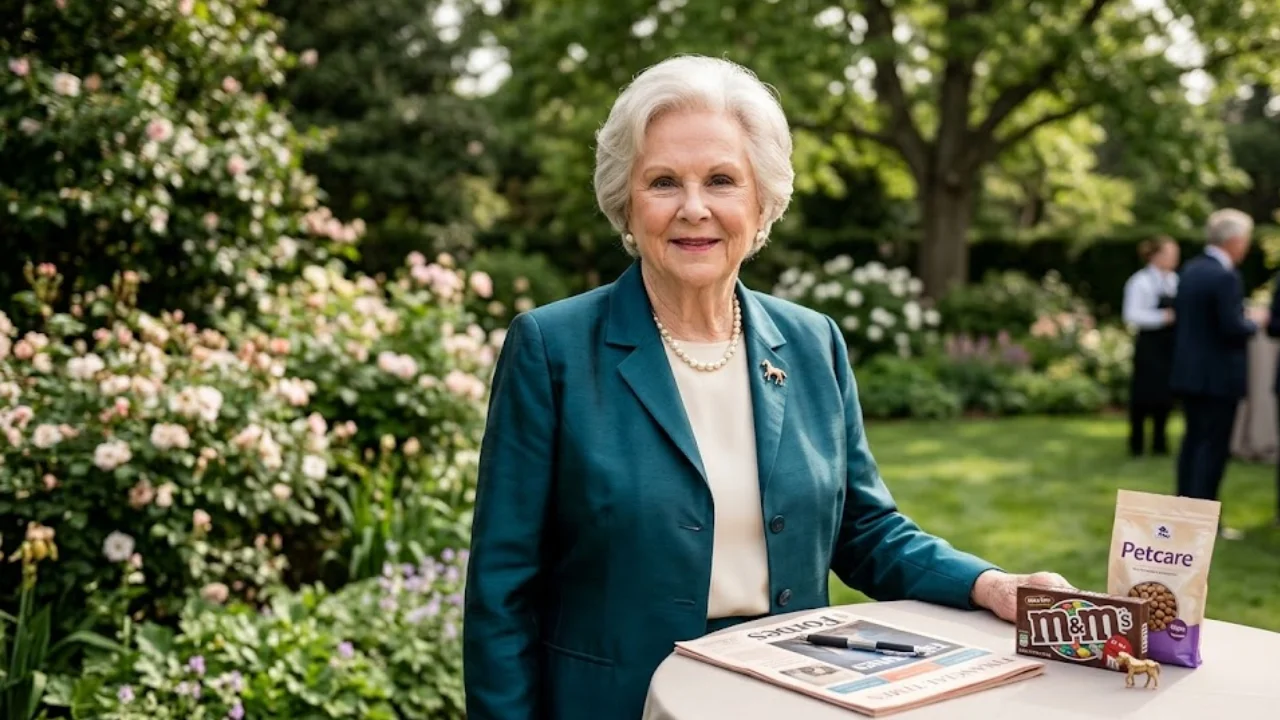
There are billionaires who make noise, and then there are billionaires who quietly build some of the most enduring wealth in human history. Jacqueline Mars belongs firmly in the second category. While tech founders and celebrity CEOs dominate financial headlines, this 86-year-old heiress has spent decades accumulating one of the largest personal fortunes on the planet — all without ever seeking the spotlight.
If you have eaten a Snickers bar, ripped open a bag of M&Ms, or fed your dog Pedigree kibble, you have already contributed, in some small way, to her extraordinary net worth.
So who exactly is Jacqueline Mars, how much is she truly worth in 2026, and what is the real story behind the woman and the dynasty? Let us get into all of it.

Who Is Jacqueline Mars?
Jacqueline Mars is an American billionaire heiress, former corporate executive, and dedicated philanthropist. She was born on October 10, 1939, in the United States, as the daughter of Forrest Mars Sr. and granddaughter of Frank C. Mars — the two men who built what eventually became one of the most profitable private companies the world has ever seen.
Unlike many heirs and heiresses who simply inherit wealth and coast through life, Jacqueline took an active role in the family business. She joined Mars, Incorporated in 1982 as food product group president and contributed to the company’s strategic direction for nearly two decades before stepping away in 2001. Her academic background is equally impressive — she earned a degree in anthropology from Bryn Mawr College in Pennsylvania in 1961, having previously attended the prestigious Miss Hall’s School in Pittsfield, Massachusetts.
Beyond business, she is deeply invested in the arts, equestrian culture, environmental conservation, and heritage preservation. She is, in short, a far more layered and accomplished person than the typical billionaire heiress narrative might suggest.
Jacqueline Mars Net Worth in 2026
As of 2026, Jacqueline Mars carries an estimated net worth of approximately $48 to $50 billion. This figure places her comfortably among the five wealthiest women in the United States and within the top twenty wealthiest individuals globally.
Her fortune is almost entirely rooted in her ownership stake in Mars, Incorporated. She holds approximately one-third of the company, with her brother John Mars and extended family members holding the remaining shares. Mars, Incorporated itself generates well over $47 billion in annual global revenue, a number that has grown consistently year after year. The company is entirely privately held, meaning it is not listed on any public stock exchange — which actually protects the family’s wealth from the kind of volatility that publicly traded companies experience.
The growth of Mars into pet care, veterinary services, and health-conscious food categories in recent years has added substantial new layers to the company’s overall valuation, which in turn has continued pushing Jacqueline’s personal net worth upward.
Jacqueline Mars Net Worth — Last 20 Years (2006 to 2026)
The table below tracks the estimated progression of Jacqueline Mars’ personal net worth over the past two decades, reflecting the growth of Mars, Incorporated and the broader expansion of the family’s holdings:
| Year | Estimated Net Worth |
|---|---|
| 2006 | $10.0 Billion |
| 2007 | $11.5 Billion |
| 2008 | $10.8 Billion |
| 2009 | $11.0 Billion |
| 2010 | $13.8 Billion |
| 2011 | $15.0 Billion |
| 2012 | $17.4 Billion |
| 2013 | $20.0 Billion |
| 2014 | $24.0 Billion |
| 2015 | $27.0 Billion |
| 2016 | $25.8 Billion |
| 2017 | $27.4 Billion |
| 2018 | $23.6 Billion |
| 2019 | $29.2 Billion |
| 2020 | $31.0 Billion |
| 2021 | $36.4 Billion |
| 2022 | $38.7 Billion |
| 2023 | $42.0 Billion |
| 2024 | $45.0 Billion |
| 2025 | $47.0 Billion |
| 2026 | $48–$50 Billion |
Note: These figures are based on publicly available estimates, Forbes and Bloomberg wealth tracker data, and Mars, Incorporated revenue trends. Because Mars is a privately held company, exact valuations are not publicly disclosed and figures represent best available estimates.
The general trend is clear — while there have been minor dips tied to global economic events such as the 2008 financial crisis and market fluctuations in 2016 and 2018, the long-term trajectory of Jacqueline Mars’ wealth has been consistently and powerfully upward.

The Mars Empire: Far Bigger Than Just Candy
Most people think of Mars as the company behind M&Ms and Snickers. That is accurate, but it barely scratches the surface of what this company actually is in 2026.
Mars, Incorporated started humbly enough when Frank C. Mars began making and selling buttercream candies from his home kitchen in the early 1900s. The real breakthrough came with the Milky Way bar in 1923, which became one of the best-selling chocolate products in American history. Forrest Mars Sr. then took the company international, introducing Mars bars to Europe and eventually developing M&Ms — originally created as a portable, heat-resistant chocolate for American soldiers during World War Two.
Today, the company’s candy and snack portfolio alone is staggering. It includes Snickers, M&Ms, Milky Way, Twix, Mars Bar, Skittles, Starburst, Combos, Altoids, and through its Wrigley subsidiary — Orbit, Extra, and Doublemint gums.
But Mars has evolved far beyond confectionery. Its food division includes Ben’s Original rice, Dolmio pasta sauces, and a range of other everyday grocery items. Its pet care division is arguably the most powerful in the world, with brands like Pedigree, Royal Canin, Nutro, Whiskas, and Sheba. Beyond pet food, Mars operates one of the largest veterinary care networks globally through its Banfield and BluePearl hospital chains.
The 2021 acquisition of Kind Bars for roughly five billion dollars signaled yet another strategic pivot — this time toward health-focused snacking, a category with enormous long-term growth potential. That acquisition alone added measurable value to the company’s overall worth and, by extension, to Jacqueline’s personal fortune.
Her Active Role in the Business
There is a persistent misconception that Jacqueline Mars did nothing more than inherit money and wait for wealth to grow. The record firmly contradicts this.
She formally joined Mars, Incorporated in 1982, stepping into the role of food product group president at a time when the company was navigating a complex landscape of international competition and product diversification. For nineteen years, she was an active presence in the company’s leadership before retiring in 2001.
The Mars family has always operated with a philosophy of deep discretion. They give very few public interviews, avoid celebrity-style publicity, and run the company with a focus on long-term sustainability rather than short-term headlines. Jacqueline embodied this culture throughout her working years and continues to represent it in her personal life today.
Philanthropy: Where Her Heart Actually Lives
What truly distinguishes Jacqueline Mars from many billionaires of her generation is the sincerity and consistency of her philanthropic work. She has not simply written cheques to gain public recognition. She has made sustained, hands-on commitments to causes that clearly matter deeply to her.
She serves on the board of directors of the Washington National Opera, reflecting a genuine passion for the performing arts. She is also connected to the National Sporting Library and Fine Arts Museum, which aligns perfectly with her decades-long love of equestrian culture and sport.
On the conservation front, she sits on the National Advisory Council of the Journey Through Hallowed Ground — a federally designated National Heritage Area running from Gettysburg, Pennsylvania all the way to Charlottesville, Virginia. This stretch of land is home to some of the most significant historical and cultural sites in American history, and protecting it matters enormously for future generations.
She donates regularly to the League of Conservation Voters, an environmental advocacy group that pushes for sustainable policy at the federal and state levels. And she owns a working organic farm in Virginia, permanently protected by the Land Trust of Virginia — not a symbolic gesture, but an actual functioning farm that embodies a commitment to sustainable agriculture.
She is also a trustee of the US Equestrian Team, a role that speaks directly to her personal passion for horses, which stretches all the way back to childhood competitions.
Personal Life: Marriages, Children, and One Dark Chapter
Jacqueline Mars married her first husband, David H. Badger, in 1961 — the same year she graduated from Bryn Mawr. The couple had three children together: Alexandra, Stephen, and Christa. They divorced in 1984 after more than two decades of marriage.
Her son Stephen has built an impressive career of his own. He is a general partner at the March Group, a venture capital firm focused on food and health innovation. He also serves on the board of Island Press, a conservation-focused publisher, and co-produced the 2013 documentary film Muscle Shoals — a critically acclaimed exploration of the legendary Alabama recording studio.
In 1986, Jacqueline married her second husband, Harold Vogel. They settled in Bedminster, New Jersey and later divorced in 1994.
The most difficult chapter of her personal life came in 2013. While driving near her home in the Plains, Virginia, she crossed the center line on US Route 50 in Aldie and collided with a minivan carrying six passengers. One passenger died. Another, who was pregnant, suffered a subsequent miscarriage. Jacqueline stated that she had fallen asleep at the wheel. Post-accident testing found no drugs in her system. She was charged with misdemeanor reckless driving. It remains a tragedy that no amount of wealth or privilege can undo — and it stands as a sobering reminder that consequences do not disappear for anyone, regardless of fortune.

How Does Her Wealth Stack Up?
Within the Mars family itself, Jacqueline’s brother John Mars holds a comparable stake and net worth, while the extended family collectively represents a combined fortune estimated at over $100 billion in 2026 — cementing the Mars family as one of the three wealthiest families in the United States, alongside the Waltons of Walmart and the Koch family.
On a global scale, Jacqueline frequently appears alongside names like Alice Walton, Françoise Bettencourt Meyers, and Julia Koch when wealthiest women rankings are compiled. Her consistent presence in the top tier of those lists reflects both the stability of her asset base and the remarkable long-term growth of the Mars business.
Why Jacqueline Mars Deserves More Recognition
In an era obsessed with self-made origin stories and personal branding, Jacqueline Mars does not fit the dominant narrative. She did not build a tech startup from a dorm room or disrupt an industry with a flashy product launch. But what she has done — steward a century-old family business with integrity, contribute meaningfully to its operations for two decades, and use her wealth to protect culture, conservation, and the arts — deserves far more recognition than it typically receives.
She represents a version of wealth and influence that prioritizes depth over visibility, long-term thinking over short-term wins, and genuine impact over public applause. There is a great deal that the wider world could learn from that approach.

Frequently Asked Questions
Her net worth in 2026 is estimated at between $48 and $50 billion, making her one of the wealthiest women in the United States and the world.
Her wealth comes from owning approximately one-third of Mars, Incorporated, one of the largest and most profitable privately held companies on Earth.
Mars makes Snickers, M&Ms, Milky Way, Twix, Skittles, Starburst, Mars Bar, Pedigree pet food, Royal Canin, Dolmio, Ben’s Original, Orbit gum, Kind Bars, and many other global brands.
No. Mars, Incorporated has remained entirely privately held throughout its history. It is not listed on any stock exchange.
She turned 86 in October 2025 and will turn 87 in October 2026.
The Mars family’s combined net worth in 2026 is estimated at over $100 billion, placing them among the three wealthiest families in America.
She crossed the center line in Virginia while driving and hit a minivan. One passenger died and one suffered a miscarriage. She was charged with misdemeanor reckless driving and no substances were found in her system.
She attended Bryn Mawr College in Pennsylvania and graduated in 1961 with a degree in anthropology.
She has two brothers — Forrest Mars Jr. and John Mars — both of whom are also billionaires.
She supports the Washington National Opera, the National Sporting Library and Fine Arts Museum, the Journey Through Hallowed Ground, and the League of Conservation Voters. She also owns an organic farm protected by the Land Trust of Virginia.
Tags
Jacqueline Mars net worth 2026, Jacqueline Mars net worth history, Mars family net worth 2026, richest women in the world 2026, Mars Incorporated net worth, Jacqueline Mars biography, Mars candy company owner, billionaire heiress 2026, John Mars net worth, Forrest Mars Sr biography, Mars Incorporated revenue 2026, richest families in America, privately held company billionaire, M&Ms owner net worth, Snickers brand owner, Pedigree pet food owner, Jacqueline Mars age 2026, Mars family wealth history, wealthiest women United States, Mars Incorporated brands list